, we told you why we started Axton Robotics.
Today we get to show you what we're building.
We've been heads down for months. Designing, wiring, coding, testing. And we're finally ready to talk about it.
An idle spindle is money walking out the door.
Shop owners want their CNC machines cutting as many hours as possible. But skilled machine tenders are hard to find, hard to keep, and expensive.
We don't want to replace those people. We want each of them running several machines at once.
That means a any shop can actually use.
Most tending cells use a flat table. Parts sit on trays, and the robot reaches all the way down to find the right one.
We asked, what if the storage stood up instead?
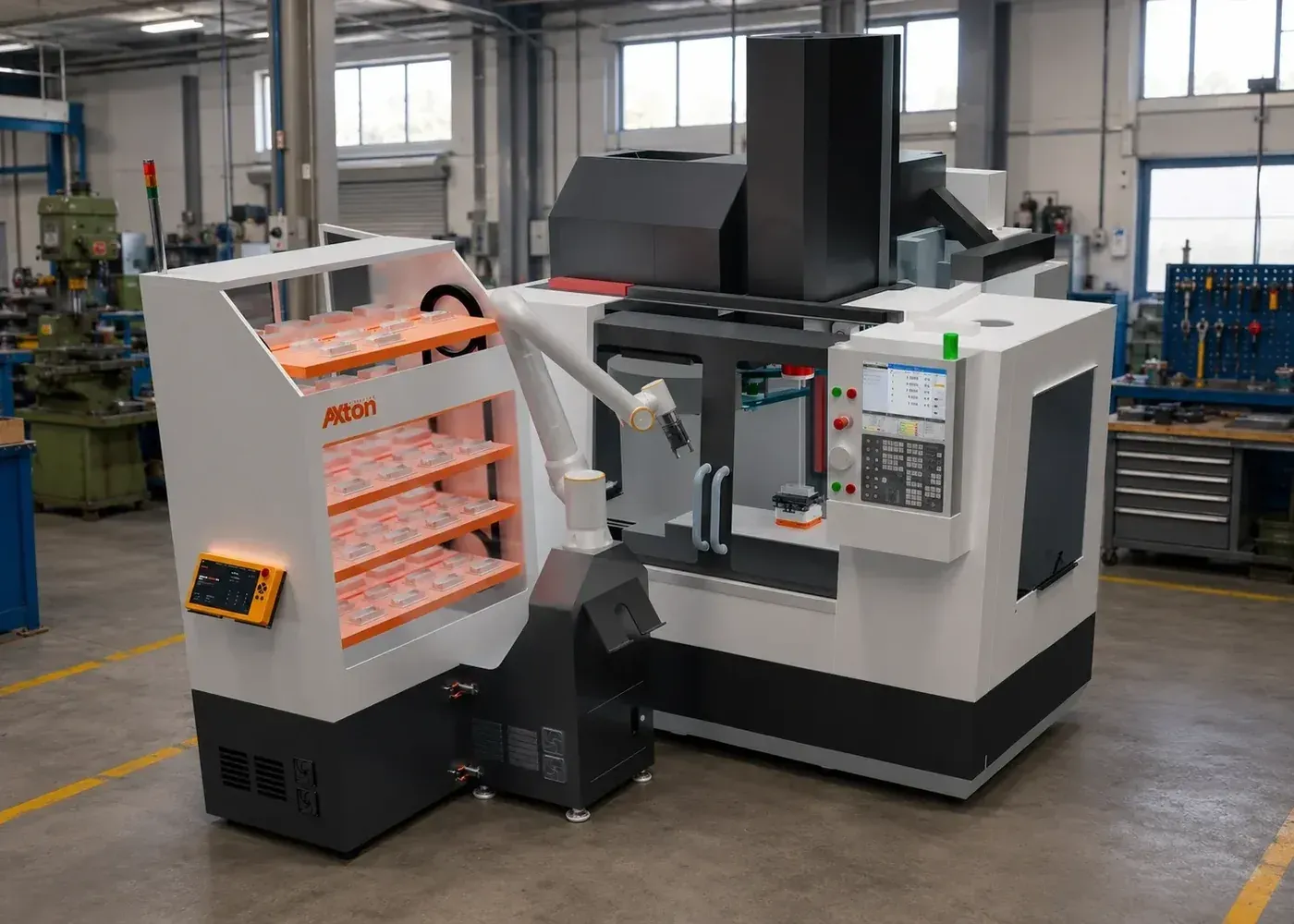
Picture a tall cabinet with 10 shelves inside. The shelves ride on a rail and rotate, like a carousel, bringing each part up to the robot exactly when it's needed.
We call it the carousel.
Each shelf carries up to 100 lb. That's 1,000 lb of parts ready to run in one compact footprint.
We're designing two cabinet sizes and three cobot sizes, 10 kg, 20 kg, and 30 kg payload. Each matched to the reach and part weight a shop needs.
The operator loads parts in the morning based on the day's workload. Programs the CNC. Programs the station in a few easy steps. Pushes one button.
Then the station takes over.
The operator controls everything from a touchscreen on the station or a mobile app.
A camera with AI vision lets the station understand what it sees and decide what to do next.
Radar watches the space around it. The station is designed to notice and react when
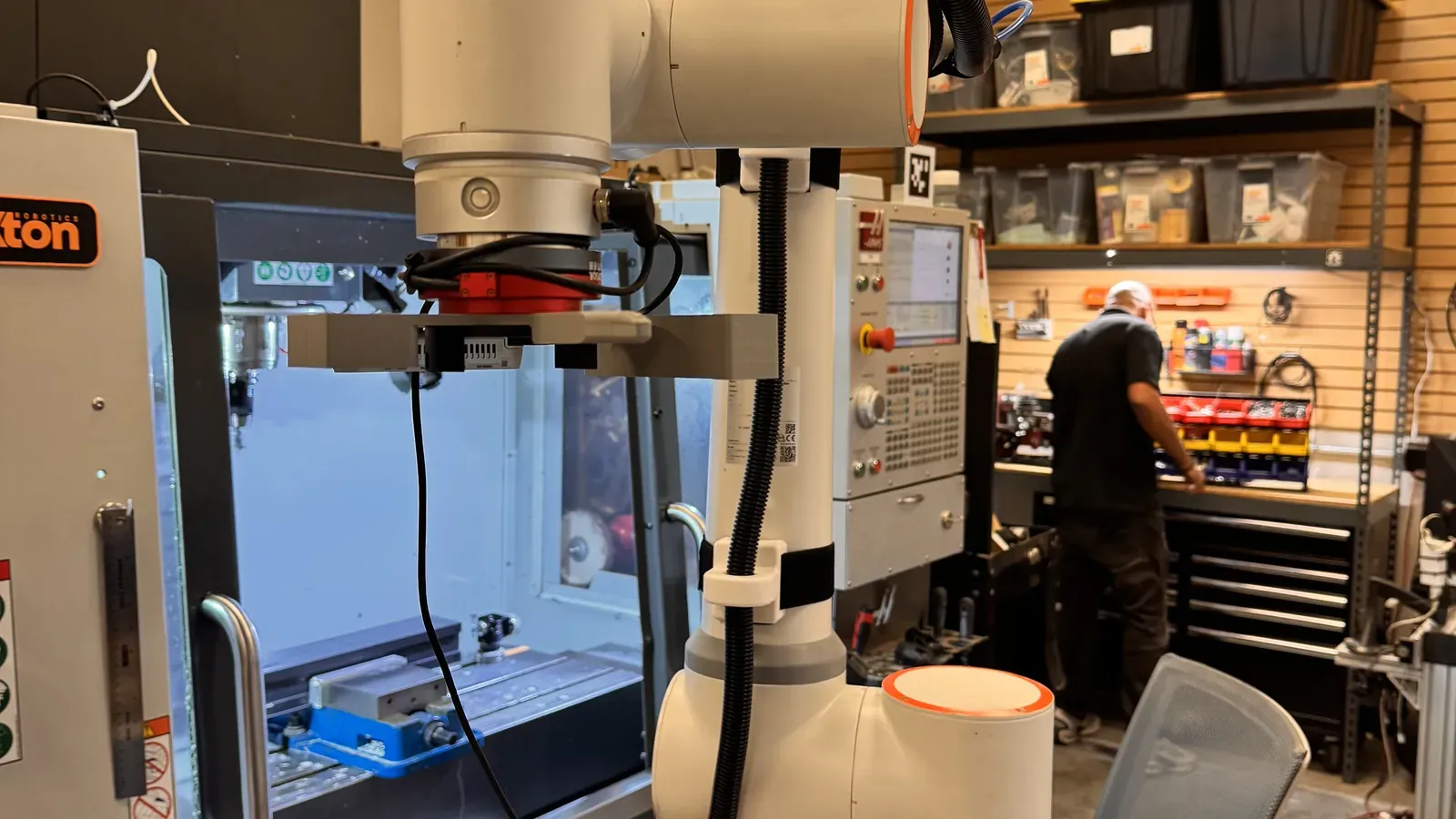
That last one matters more than people think. We use AprilTags, small printed markers the camera reads, so the robot can realign itself automatically.
If the station shifts by a millimeter overnight and nobody notices, the robot still notices. And adjusts.
Everything connects to the cloud. Shop owners and operators get notified, and our team can support the station remotely. Proactive, not reactive.
Mike has spent years around machinists. He knows every square foot in front of a CNC is fought over.
So the carousel is
No custom projects. No promises that may or may not work. Most machine tending jobs look the same, so we're building one smart station for all of them.
And support comes first. Manuals, videos, tutorials, and remote tech support, so anyone with shop experience can get it running.
Our long term aim is lights-out manufacturing. Robots running 24 hours with nobody on the floor.
That only works if accuracy and tolerance sit at the center of everything. Aerospace, defense, and medical shops can't accept a bad part.
So our roadmap includes automated quality checks on every part after it's machined.
We've designed it. We've built it. We've tested the moving parts, the vision, the software, and the arm together.
And it works.
Now we're refining every detail before the carousel meets its first shops. We'll keep sharing the build here, the wins and the headaches.
Run a CNC shop and want an early look? . We'd love to hear what your floor needs.
The carousel is a mobile, plug-and-play CNC machine tending station from Axton Robotics. A cobot arm loads and unloads the CNC while a tall cabinet with 10 rotating shelves brings each part up to the robot.
Each of the 10 shelves carries up to 100 lb, so the carousel holds up to 1,000 lb of parts in one compact footprint.
The camera reads AprilTags, small printed markers, so the robot can realign itself automatically, even if the station shifts by a millimeter overnight.
No. The carousel is on wheels, with nothing bolted to the floor, so it can roll to a different CNC the next morning.
How a 12-year friendship between a Cairo software founder and a San Diego engineer became Axton Robotics, a plug-and-play CNC automation company.

Malak Mitch
Jan 15, 2026 — 7 min read
A mobile CNC tending robot gets bumped. Nobody notices. Here's how AprilTags let the Axton Robotics station find the shift and correct itself.

Michael Nessim
Apr 30, 2026 — 3 min read