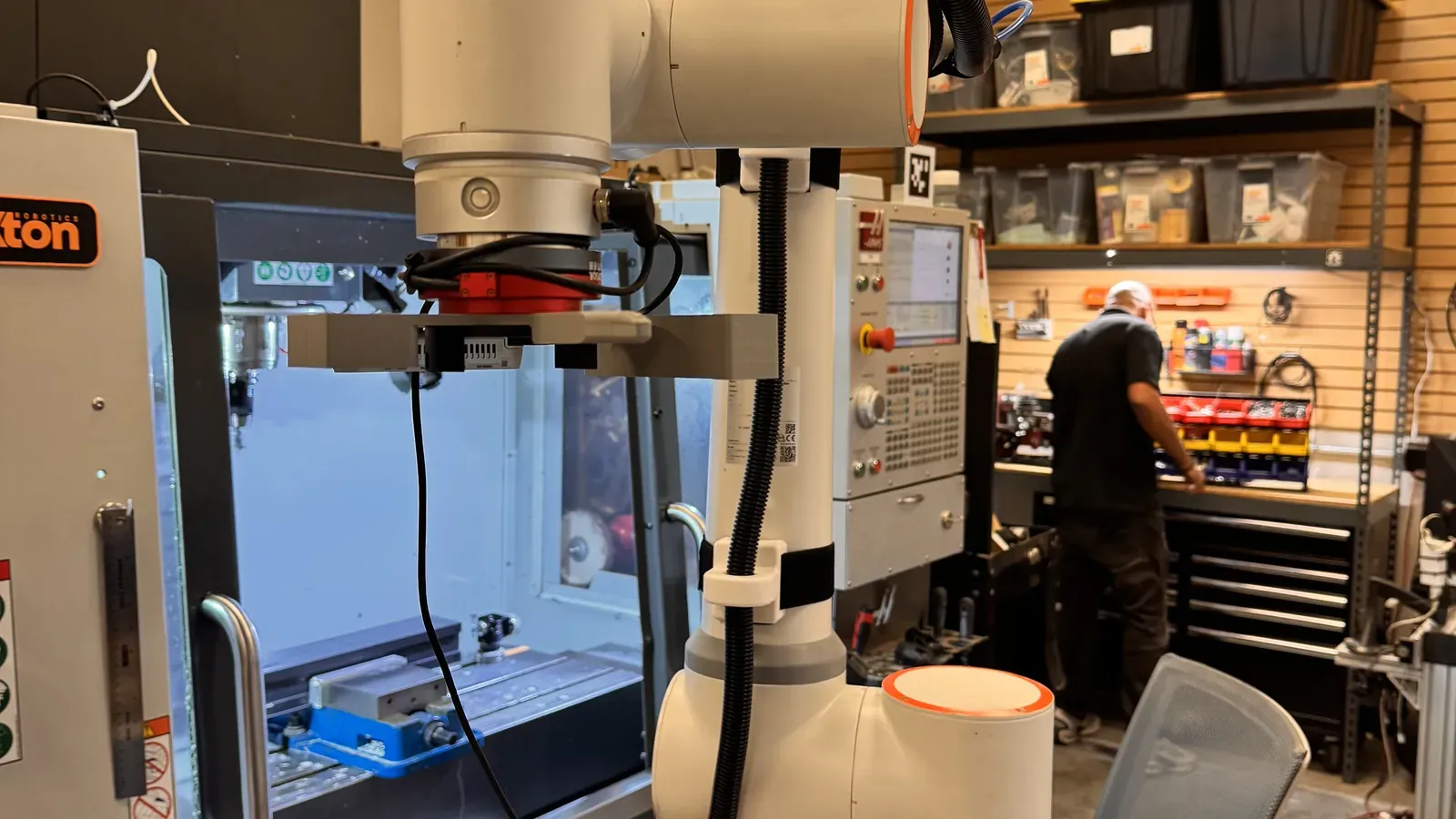
It's 6am. The shop is quiet.
Sometime last night, a cart clipped the corner of the robot station. It moved one millimeter.
Nobody saw it. Nobody felt it. Nobody would ever know.
Except the robot is about to load a part into a vise with tolerances tighter than that.
A robot arm doesn't see the world the way you do. It remembers positions.
Teach it where the vise is, and it will go back to that exact spot thousands of times. Perfectly.
That's the strength. It's also the trap.
If the station or the CNC moves, the robot keeps going to the old spot. Now the part lands crooked. Or it doesn't seat. Or the gripper hits the vise.
Best case, a scrapped part. Worst case, a crash and a very expensive morning.
Most machine tending cells solve this the hard way.
Bolt the robot to the floor. Pin the machine in place. Call a technician to recalibrate whenever anything changes.
It works. But it kills the one thing small shops need most, flexibility.
. Roll it to a different machine in the morning. Move it when the job changes. That only works if the robot can find its own way again.
AprilTags look like simple black and white squares. A bit like QR codes.
But they aren't built to hold a website link. They're built to tell a camera exactly where it is.
They came out of robotics research at the University of Michigan, and today they're used everywhere from research labs to drones.
When a camera sees an AprilTag, it can calculate the tag's position and angle in space. Not roughly. Precisely.
We place AprilTags at known points on the station and around the CNC.
The station's camera reads them and compares what it sees with what it expects.
If everything matches, the robot carries on.
If something shifted, even by a millimeter, the station calculates the offset and adjusts the robot's path to match the new position.
No technician. No recalibration day. No guessing.
For a shop owner, this turns into a few very practical things.
AprilTags aren't magic.
The camera needs to see them clearly. A tag covered in coolant or chips won't help anyone. So keeping them clean is part of the routine, just like wiping down the machine.
And they don't replace a good setup. They protect it.
The whole point of a machine tending robot is to run when nobody is watching.
That only works if you trust it at 3 am.
AprilTags are one of the quiet reasons you can.
: AI vision.
Want to see how it handles your shop floor? .
Most machine tending robots are blind and need perfect fixtures. Here's how AI vision lets the Axton Robotics station find, check, and handle parts.

Michael Nessim
May 14, 2026 — 3 min read
CNC shops can't find or keep machine tenders, and idle spindles cost money every hour. Here's how robotic machine tending helps shops grow their people.
Michael Nessim
May 28, 2026 — 3 min read